



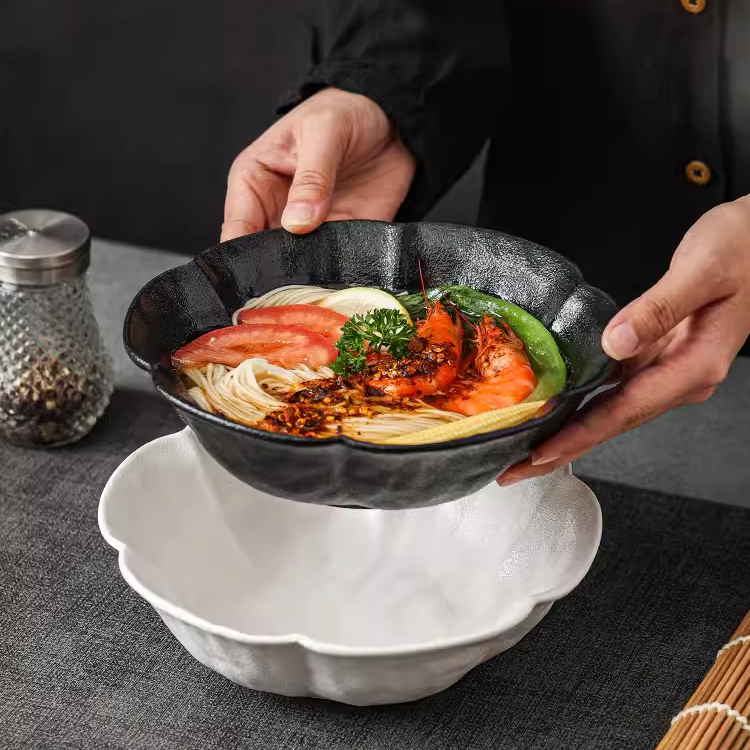
As the global restaurant industry booms, Japanese ramen has become a staple in chain, Asian, and fusion eateries. For restaurant owners and tableware buyers, selecting the perfect ramen bowl shapes dining presentation, customer experience, and brand identity.
That’s why a structured evaluation of Ramen Bowls Wholesale — covering capacity, design, material, and durability — is essential for bulk buyers.
A suitable ramen bowl should balance the proportions of capacity and broth/noodle ratio, provide a comfortable grip, stack efficiently, and facilitate smooth operation in the restaurant. Different markets also have different preferences for capacity and aesthetic style.
This guide breaks down professional choices for Ramen Bowls Wholesale across five key areas: capacity standards, bowl structure, material selection, real restaurant scenarios, and bulk-purchasing tips.
Ramen Bowl Size Selection: The Golden Ratio of Soup to Noodles
1. Common Size Range Analysis
In Ramen Bowls Wholesale purchasing, size is usually a primary consideration. Common size ranges on the market include:
- 900ml–1000ml: Suitable for smaller portions or female consumers
- 1100ml–1300ml: Standard commercial size
- 1400ml–1600ml: Large portion or premium rich broth ramen
Generally, a standard bowl of ramen requires approximately 300–400g of noodles and 500–700ml of broth. Insufficient bowl size can lead to spillage; excessive size makes the portion appear small and affects visual appeal.
2. The Impact of Soup-to-Noodle Ratio on Customer Experience
Based on experience in the catering industry, the ideal soup-to-noodle ratio is “seven-tenths full.” This not only prevents spillage during serving but also allows the layers of ingredients to be clearly visible. When selecting Ramen Bowls Wholesale, it is recommended to ask the supplier to provide samples to test the actual serving effect.
3. Different Market Capacity Preferences
- North American market prefers 1200ml and above
- Southeast Asian market mostly chooses 1000ml–1200ml
- High-end Japanese restaurants prefer larger diameter, shallower bowls
Capacity determines the cost per bowl and transportation volume; therefore, a comprehensive evaluation considering logistics and restaurant positioning is necessary when pursuing Ramen Bowls Wholesale.

Ramen Bowl Shape Analysis: Traditional vs. Modern Structures
1. Classic Tall, Deep Bowl
Traditional Japanese ramen bowls are mostly tall, deep bowls with flared walls and a slightly tapered bottom. Advantages include excellent heat retention and visual appeal, making them suitable for rich tonkotsu ramen broth.
During Ramen Bowls Wholesale, this type of bowl is suitable for restaurants with a traditional style.
2. Wide-Mouthed Bowls with Straight Walls
Modern restaurants prefer wide-mouthed designs, making it easier to display toppings like char siu and soft-boiled eggs. This also enhances the visual appeal and is suitable for social media sharing.
3. Conical Structure
Conical structures facilitate stacking and save storage space. For chain restaurants or central kitchen distribution systems, prioritizing highly stackable structures during Ramen Bowls Wholesale can reduce storage costs by approximately 10–15%.
4. Bowl Diameter and Grip Comfort
The ideal diameter is typically 18–22cm. Too wide a diameter affects holding stability, while too narrow a diameter hinders topping placement. A feel test is recommended before the Ramen Bowls Wholesale.


Material Selection: Differences Between Stoneware and Porcelain
In Ramen Bowls Wholesale procurement, materials directly impact durability and brand positioning.
1. Stoneware
- Heavyweight, excellent heat retention
- Diverse surface glazes, suitable for a handcrafted feel
- Highly impact-resistant
Suitable for restaurants emphasizing a traditional or natural style.
2. Porcelain
- Delicate texture
- Relatively lightweight
- Low water absorption, easier to clean
More suitable for high-end or modern minimalist restaurants.
3. Heat Resistance and Dishwasher Suitability
In commercial settings, bowls must withstand washing with water above 120℃. When choosing Ramen Bowls Wholesale, ensure the product meets hotel-grade heat resistance and crack resistance standards.
Commercial Durability and Thickness Control
1. Recommended Bowl Wall Thickness
Commercial ramen bowls typically have a wall thickness of 4–6mm. Too thin and they are fragile; too thick increases weight and transportation costs.
2. Weight Control
The recommended weight for a single ramen bowl is 800g–1100g. Excessive weight affects server efficiency. In the Ramen Bowls Wholesale, the impact of the total container weight on shipping costs should be considered.
3. Reinforced Edge Design
Thickened rolled edges can be used on easily damaged areas of the bowl rim to reduce breakage by approximately 20%. This is especially crucial for bulk purchases.
Wholesale Procurement Strategy: MOQ, Customization, and Cost Optimization
1. Minimum Order Quantity and Flexibility
During the Ramen Bowls Wholesale, many restaurants wish to place small trial orders. The minimum order quantity (MOQ) varies depending on the specifications, glaze, and customization complexity of different products.

2. Custom Logos and Patterns
Branding can be achieved through screen printing, decals, underglaze decoration, etc. The larger the batch size, the lower the cost per customized item.

3. Transportation and Packaging Optimization
Using corrugated packaging or palletized stacking can reduce breakage rates. Properly designed box sizes can reduce ocean freight costs by 5–8%.
Conclusion
Choosing the right ramen bowls is not just a simple utensil purchase, but a crucial aspect of restaurant brand building. When making Ramen Bowls Wholesale decisions, factors such as capacity ratio, bowl shape, material differences, durability standards, and logistics costs should be considered. Appropriate size selection not only enhances the customer dining experience but also reduces long-term operating costs.
For restaurant operators and importers, finding manufacturers with production experience and customization capabilities is key to ensuring stable supply and quality assurance.
About Yongjian Ceramics
Established in 1990, Yongjian Ceramics is a professional ceramic tableware manufacturer specializing in the production and wholesale of ceramic plates, bowls, cups, baking dishes, spoons, and other products. We have a mature production system and extensive customisation experience, offering a variety of capacities, shapes, and glaze options to meet customer needs.
In the Ramen Bowls Wholesale sector, we support flexible ordering with low minimum order quantities, facilitating market testing and phased purchasing for restaurant clients. The specific minimum order quantity will be determined based on product specifications and customization requirements. Please contact our sales team for detailed solutions and quotations.
FAQ
Q1: What is the optimal capacity for a ramen bowl?
Standard commercial capacity is 1100ml–1300ml, which meets the needs of most ramen recipes.
Q2: Does Ramen Bowls Wholesale support small batch orders?
Yes. The specific minimum order quantity depends on product specifications and customization requirements; please contact sales for confirmation.
Q3: Which material is more durable?
Stoneware offers better impact resistance, while Porcelain is lighter and easier to clean. The choice should be based on the restaurant’s positioning.


