
In today’s increasingly competitive foodservice industry, restaurant operators, hotel purchasers, chain brands, and distributors all seek to lower procurement costs without compromising product quality. For bulk orders, wholesale restaurant tableware impacts not only overall operating costs but also brand image, customer experience, and long-term maintenance expenses.
When selecting suppliers, many buyers focus solely on unit price while overlooking factors such as shipping, breakage rates, customization costs, inventory pressure, and the value of long-term partnerships. In reality, a set of wholesale restaurant tableware that appears inexpensive up front may ultimately result in a higher total cost of ownership than a higher-quality product. Therefore, analyzing procurement strategies from a holistic supply chain perspective is essential to truly reducing budgets and maximizing return on investment (ROI).
This article provides an in-depth analysis of how to effectively reduce procurement costs for wholesale restaurant tableware by examining five key areas: supplier selection, material choice, customization strategies, shipping and packaging, and long-term partnerships. It offers valuable insights for foodservice brands and wholesale buyers alike.
1. Look Beyond Unit Price: Calculate the Total Cost of Ownership
When making inquiries, many purchasing agents start by asking, “What’s your best price?” However, truly professional buyers focus on the Total Cost of Ownership (TCO).
When sourcing wholesale restaurant tableware, consider the following cost factors:
- Product purchase price
- International logistics costs
- Packaging costs
- Shipping breakage rates
- Restocking costs
- Warehousing costs
- Product lifespan
- After-sales service costs
For example:
Suppose Factory A quotes $8.00 per tableware set, while Factory B quotes $8.50. Option A might appear cheaper, but the reality could look like this:
| Item | Factory A | Factory B |
|---|---|---|
| Product Price | $8 | $8.5 |
| Shipping Damage Rate | 6% | 1% |
| Replenishment Cost | High | Low |
| Service Life | 2 years | 4+ years |
| Packaging | Standard | Reinforced |
Ultimately, although Factory B has a slightly higher unit price, it offers a lower total procurement cost.
For restaurants operating over the long term, highly durable wholesale restaurant tableware often reduces the need for repeat purchases and boosts overall profit margins.
2. Choose manufacturers with OEM/ODM capabilities to cut out middlemen
Many buyers still source tableware through trading companies rather than working directly with factories.
In fact, partnering directly with a professional manufacturer often yields the following advantages:
More competitive pricing
Without the markups added by trading companies, pricing is more transparent.
Faster production cycles
With fewer communication layers, it is easier to approve samples, adjust designs, and schedule production.
Greater customization flexibility
For example:
- Logo printing
- Exclusive glaze colors
- Custom sizes
- Custom packaging
- Gift box design
- Development of unique shapes
For restaurant chains, a unified visual identity effectively boosts brand recognition, and OEM production is generally less expensive than post-production customization.
Furthermore, manufacturers with established R&D teams can offer product development advice based on market trends, helping buyers create more competitive product lines.

3. Select materials based on your restaurant’s positioning, rather than blindly chasing high-end products
When sourcing wholesale restaurant tableware, a higher price does not always mean a better choice; the key is to select the material best suited to your specific usage scenario. For example:
Fast Food Chains
Recommended choices:
- High-durability porcelain
- White porcelain
- Minimalist designs
Characteristics:
- Lower cost
- Easy to restock
- Suitable for high-frequency use


Specialty Coffee Shops
Recommended choices:
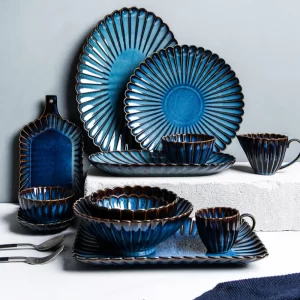
- Reactive glaze finishes
- Stoneware
- Handcrafted texture
Characteristics:
- Distinctive brand identity
- Enhanced social media appeal
- Elevated customer experience


High-end Hotels
Recommended choices:
- Bone china
- Fine porcelain
- Custom gold-rim detailing
Characteristics:
- Premium quality
- Ideal for banquets and business entertaining
If the budget is limited, consider a “high-quality core items + standardized auxiliary items” procurement strategy. For example:
- Use high-end lines for main dinner plates
- Use standard lines for side plates
- Standardize specifications for soup bowls
- Use universal sizes for glassware
This approach maintains an overall premium feel while effectively controlling procurement costs.


4. Optimizing packaging, shipping, and inventory management can also reduce procurement costs
Many businesses overlook logistics costs, yet international shipping often accounts for 15%–30% of total procurement costs.
Therefore, when sourcing wholesale restaurant tableware, consider optimizing the following areas:
Optimize packaging dimensions
Smart packaging design can improve container loading efficiency.
For example:
Increasing the load volume of a 40HQ container by just 10% can significantly lower overall shipping costs.
Use shock-resistant packaging
Reinforcing foam, using impact-resistant dividers, and strengthening carton structures can effectively reduce breakage rates during transit.
Data shows that high-quality packaging can keep international shipping breakage rates between 1% and 2%, whereas standard packaging may result in rates exceeding 5%.

Plan inventory strategically
Avoid purchasing a full year’s stock at once.
Instead, align procurement with sales plans by:
- Staggering production
- Staggering shipments
- Implementing rolling replenishment
This reduces the amount of capital tied up in inventory and lowers warehousing costs.
Reliable delivery schedules from suppliers further facilitate the creation of a flexible supply chain.
5. Establishing Long-Term Partnerships Saves More Money Than Frequently Switching Suppliers
Many buyers frequently switch suppliers in search of lower quotes.
However, this practice often incurs hidden costs:
- Inconsistent quality from new suppliers
- Need for repeated sample approvals
- Redundant mold development
- Increased communication costs
- Higher risks regarding delivery schedules
Conversely, long-term partnerships often offer significant advantages:
More Favorable Pricing
Suppliers typically offer more competitive prices as procurement volumes increase.
More Consistent Quality
Long-term cooperation allows for the establishment of unified quality standards, minimizing batch-to-batch variations.
Faster Delivery
Production processes become more efficient once the supplier is familiar with the client’s specific needs.
Priority Access to New Products
Top-tier manufacturers often prioritize long-term clients when introducing new products and trending designs, helping them seize market opportunities.
For brands that regularly source wholesale restaurant tableware, establishing a strategic partnership is far more valuable than simply chasing the lowest price.

Conclusion
Reducing procurement costs for wholesale restaurant tableware is not merely about finding the cheapest products; it requires a holistic approach that considers product quality, supplier capabilities, shipping efficiency, inventory management, and long-term partnerships.
For restaurants, hotels, restaurant chains, and tableware wholesalers, a sound procurement strategy can effectively lower overall operating costs while enhancing brand image and customer satisfaction. By selecting experienced manufacturers, strategically planning product assortments, optimizing logistics and packaging, and building stable supply partnerships, businesses can mitigate procurement risks, improve supply chain efficiency, and achieve long-term, sustainable growth.
As the global foodservice industry evolves, high-quality, cost-effective wholesale restaurant tableware that supports flexible customization is becoming the preferred choice for an increasing number of buyers. Establishing a reliable supply chain early on will help businesses gain a significant cost advantage and a stronger competitive edge in the market.

Why Choose Yongjian Ceramics?
Founded in 1990, Yongjian Ceramics is a professional ceramic tableware manufacturer with extensive industry experience. We specialize in the R&D, production, and wholesale of ceramic plates, bowls, mugs, baking dishes, spoons, and more. The company provides reliable OEM/ODM customization services to global restaurant brands, importers, wholesalers, and retailers, offering personalized solutions regarding size, color, glaze, patterns, logos, and packaging to meet specific client needs.
Yongjian Ceramics maintains strict quality control and stable production capacity, helping clients secure products that combine high quality with competitive pricing. Additionally, the company offers low minimum order quantities (MOQs), allowing for flexible ordering. MOQs vary by product; please contact the Yongjian Ceramics sales team for details and professional purchasing advice.

FAQ
Q1: How do I choose the right wholesale restaurant tableware?
We recommend considering factors such as your restaurant’s positioning, budget, usage frequency, and brand style. Fast-food outlets are better suited to durable, easily restocked standardized products, whereas fine-dining establishments might opt for tableware with unique designs or distinctive glazes to enhance the overall dining experience.
Q2: Does customizing wholesale restaurant tableware significantly increase costs?
Not necessarily. Partnering directly with a manufacturer capable of OEM/ODM services often keeps the costs of customizing logos, colors, or packaging low—especially with bulk orders—while simultaneously boosting brand image and market competitiveness.
Q3: How can I minimize breakage during international shipping?
We recommend choosing a manufacturer with export experience that utilizes professional packaging solutions—such as thickened cartons, shock-absorbing dividers, and foam protection—and employs smart container loading strategies. These measures effectively reduce breakage rates and lower costs associated with after-sales service and restocking.
Q4: Why is a long-term partnership more cost-effective than frequently changing suppliers?
Long-term partnerships ensure consistent product quality, better pricing, faster delivery times, and ongoing support for new products. They also eliminate the hidden costs associated with re-sampling, communication, and switching supply chains.