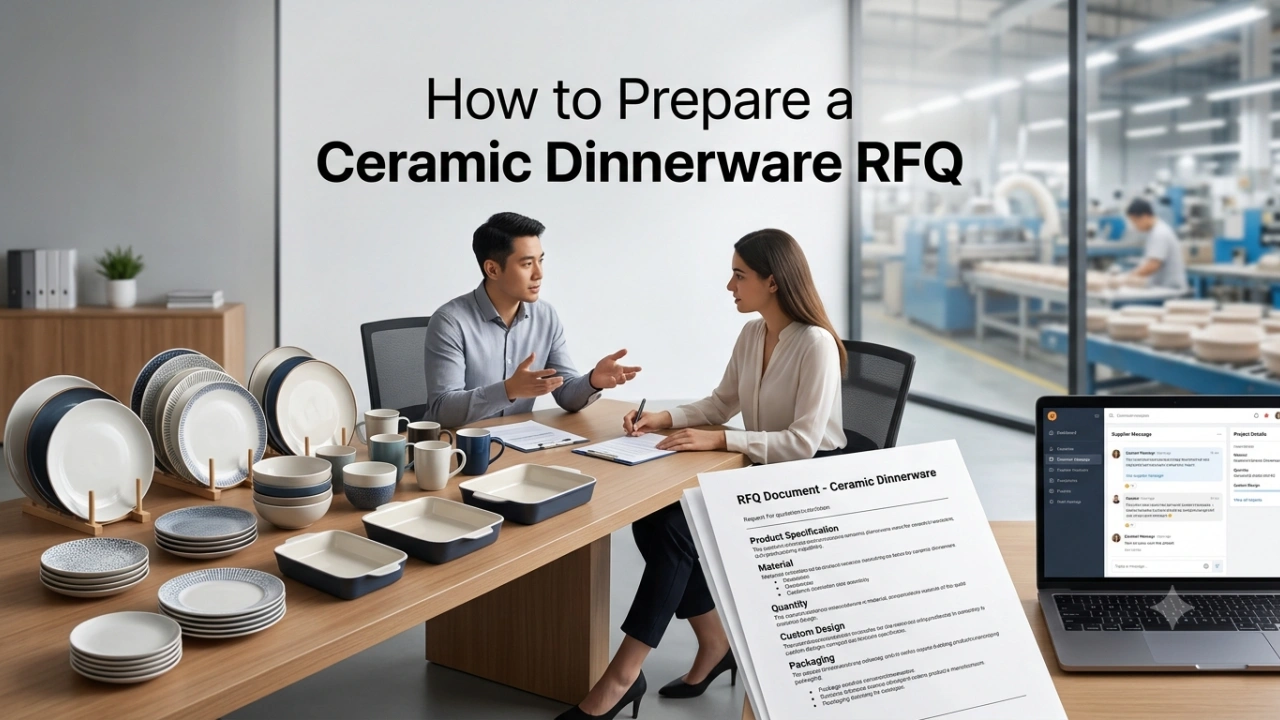
Prepare a professional Ceramic Dinnerware RFQ, which needs to clarify product specifications, material requirements, quantity, customization needs, quality standards, packaging methods and delivery information, so that ceramic tableware manufacturers can quickly and accurately quote and reduce subsequent communication costs.
Why is it important to prepare a professional Ceramic Dinnerware RFQ?
For importers, wholesalers, catering brands and retail companies, purchasing ceramic tableware is not simply asking about the price. A complete procurement requirements document directly affects whether the supplier can provide an accurate quotation.
When many buyers send inquiries, they only provide simple information such as “need 1,000 sets of white ceramic tableware”, but manufacturers cannot determine the specific requirements, such as:
*What type of product is it?
- What ceramic material is used?
- Do you need a brand logo?
- Are there any special testing requirements?
- Does the packaging require retail design?
- What are the certification requirements for the target market?
Therefore, a detailed Ceramic Dinnerware RFQ can help both parties quickly confirm project requirements, improve procurement efficiency, and allow suppliers to better evaluate production costs.
For ceramic tableware procurement, RFQ is not only an inquiry document, but also a project communication standard. An excellent RFQ can reflect the professionalism of the buyer and also help the factory determine the match of the project.
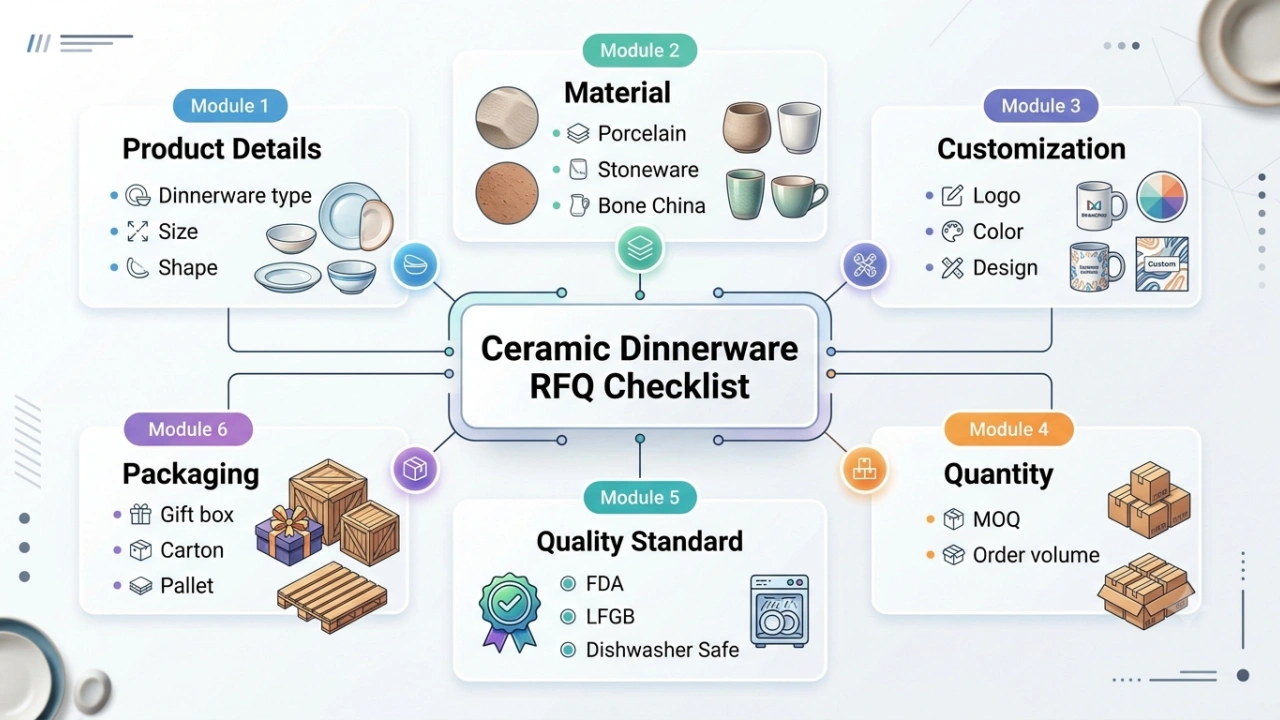
What core information does the Ceramic Dinnerware RFQ need to contain?
1. Clarify product type and procurement scope
First, the product category being purchased needs to be clearly described.
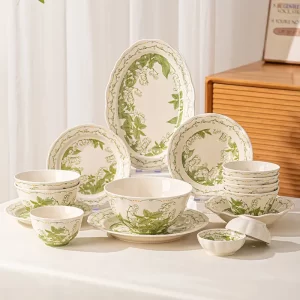
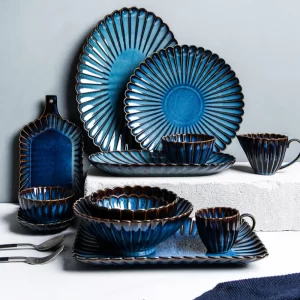
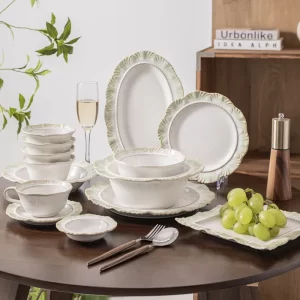
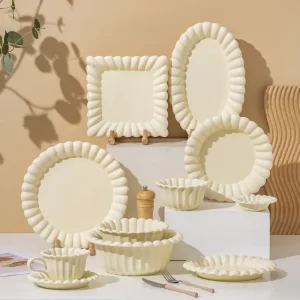
There is a wide range of ceramic tableware, including:
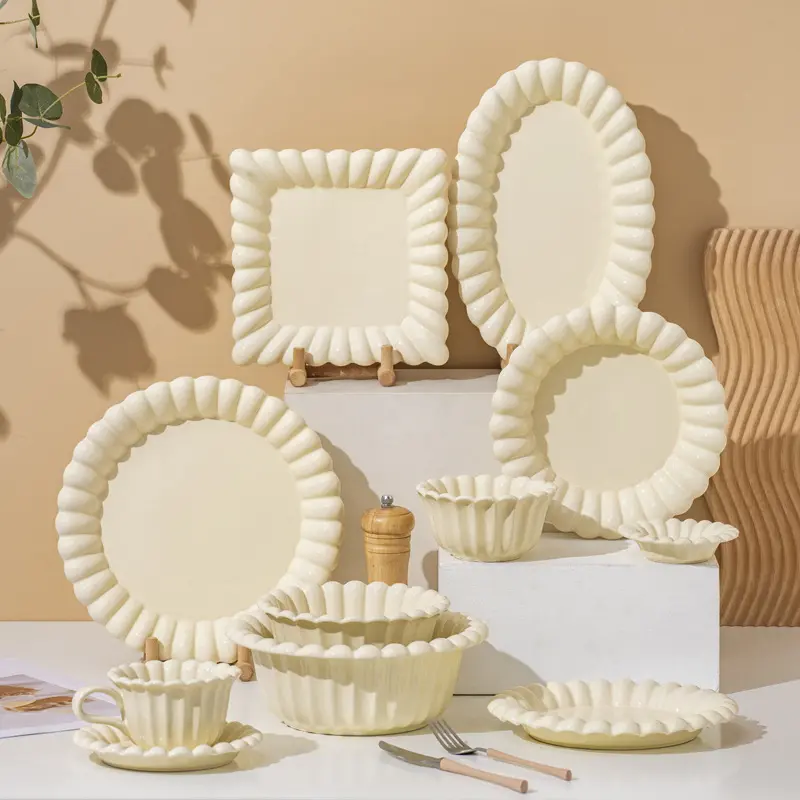
- Ceramic plates
- Ceramic bowls
- Ceramic mugs
- Ceramic baking dishes (ceramic baking utensils)
- Ceramic spoons
- Dinnerware sets
When creating a Ceramic Dinnerware RFQ, it is recommended to provide a specific product name rather than using an overly broad description.
For example:
Error:
We need ceramic tableware.
Better expression:
We need 12-piece stoneware dinnerware sets, including dinner plates, salad bowls, mugs and dessert plates.
The more detailed the product description, the easier it is for suppliers to provide accurate quotes.
2. Explain ceramic material and process requirements
Different ceramic materials affect product cost, quality and market positioning.
Common materials include:
- Porcelain (porcelain)
- Stoneware
- Bone China (Bone China)
- Earthenware (pottery)
In addition, the surface treatment needs to be stated, for example:
- Glossy glaze (glossy glaze)
- Matte glaze (matte glaze)
- Reactive glaze (kiln variable glaze)
- Hand-painted decoration (hand-painted decoration)


Many buyers tend to overlook the details of the process, but in fact, the glaze effect, color stability and production difficulty will all affect the final price.
Yongjian Ceramics recommends that buyers provide reference pictures, design drafts or sample pictures in the RFQ, because visual information is usually more accurate than text descriptions.
3. Provide size, capacity and product specifications
Size information is an important basis for ceramic tableware quotations.
For example:
- Plate diameter: 10 inches
- Bowl capacity: 500ml
- Mug capacity: 12oz
- Baking dish size: 30×20cm
If the product is used in restaurants, hotels or retail markets, the product usage scenario also needs to be described.
For example:
- Home dining
- Restaurant service
- Hotel tableware
- Gift packaging
- Supermarket retail
Adding size information to the complete Ceramic Dinnerware RFQ can avoid quotation deviations and reduce the number of modifications during the proofing stage.
4. Explain the purchase quantity and order plan
MOQ (Minimum Order Quantity) is an important factor in ceramic manufacturing.
Buyers should provide:
- Initial order quantity (first purchase quantity)
- Annual purchase volume (annual purchase volume)
- Future order plan (future purchase plan)
For example, a new brand may purchase 3,000 sets for the first time, but plans to purchase 50,000 sets per year in the future. This information will affect the factory’s judgment on price, mold costs, and cooperation methods.
A unique piece of purchasing advice: Don’t just focus on the first order price. For ceramic products, long-term stable orders are often easier to obtain manufacturer support than one-time low prices.
5. Add customization requirements and brand information
Many overseas customers choose Chinese ceramic factories not just to purchase spot goods, but also to develop their own products.
Therefore, the RFQ should state:
- Logo printing (Logo printing)
- Custom color
- Custom shape (shape design)
- Custom packaging
- Custom mold development
The complete Ceramic Dinnerware RFQ helps manufacturers evaluate design capabilities and development cycles in advance.
For brand customers, it is recommended to provide brand positioning at the same time, such as:
- Premium lifestyle brand
- Affordable restaurant supplier
- Eco-friendly tableware brand
In this way, suppliers can recommend more suitable materials and processes based on market positioning.
How to Get A More Accurate Quote for Ceramic Dinnerware RFQ?
Provide quality standards and testing requirements
Different markets have different requirements for ceramic tableware.
For example:
- FDA requirements (US market)
- LFGB standards (European market)
- Food contact safety requirements


If the procurement market has special regulatory requirements, the RFQ should be written in advance.
In addition, you can indicate:
- Dishwasher safe
- Microwave safe
- Oven safe
- Lead-free requirement
This information directly affects the production process and inspection costs.
Clarify packaging and shipping requirements
Ceramic products are fragile, so packaging is very important.
It is recommended that the RFQ include:
- Individual box packaging
- Gift box packaging
- Bulk carton packaging
- Pallet requirements
Also available:
- Shipping destination
- Preferred shipping method
- Required delivery date

A detail that is easily overlooked is that packaging costs may account for an important proportion of the export costs of ceramic tableware. If buyers state their packaging needs in advance, they can avoid re-evaluating prices later.
Common mistakes: Why can’t you get an accurate quote for your RFQ?
Only asks for price, does not provide product information
“Please send your best price” is a common expression in many purchase emails, but manufacturers lack the necessary information and usually can only reply with reference prices.
Ignore product usage
The same set of tableware is used in home retail and five-star hotels, with completely different requirements for quality, packaging and design.
No target market specified
There are differences in color, size and design preferences among consumers in different countries.
For example:
- The European market pays more attention to simple design and environmental certification;
- The US market pays more attention to durability and home use scenarios;
- The Middle Eastern market may prefer large-capacity tableware and special decorations.
Adding market information to the Ceramic Dinnerware RFQ can help suppliers provide solutions that better meet their needs.
FAQ: Frequently asked questions about Ceramic Dinnerware RFQ
Q1: What information should be included in a Ceramic Dinnerware RFQ?
A complete RFQ usually includes product type, material, size, quantity, process, packaging, certification requirements and delivery time.
Q2: Can manufacturers help design ceramic dinnerware products?
Yes. Many professional ceramic manufacturers provide OEM and ODM services, including product design, mold development, color adjustment and packaging solutions.
Q3: What is the MOQ for custom ceramic tableware?
MOQ depends on product type, process complexity and customization requirements. Ordinary products usually have lower MOQs, while special molds or complex process products require higher MOQs.
Q4: How long does ceramic dinnerware production take?
The production cycle is usually affected by product design, sample confirmation, order quantity and production schedule. Customized projects usually need to go through several stages of design, proofing, confirmation and mass production.
How to choose a suitable ceramic tableware manufacturer?
In addition to price, buyers should also pay attention to:
- Factory experience
- Production capacity
- Quality control system
- OEM/ODM capability
- Export experience
Excellent suppliers can not only produce products, but also help customers optimize designs, reduce costs, and solve problems during the export process.
Choose Yongjian Ceramics as Your Ceramic Dinnerware Partner
Founded in 1990, Yongjian Ceramics is a professional Ceramic Tableware Manufacturer that has long been committed to the production and wholesale of ceramic tableware. Its products cover ceramic plates, ceramic bowls, ceramic cups, ceramic baking dishes, ceramic spoons and various customized tableware products.
With many years of ceramic manufacturing experience, Yongjian Ceramics has rich OEM/ODM capabilities and can provide global customers with one-stop services from product design, process development, sample production to mass production.
If you are looking for a reliable ceramic tableware supplier, welcome to submit your purchasing requirements to Yongjian Ceramics; we will provide professional solutions and competitive quotations based on your market positioning and product requirements.