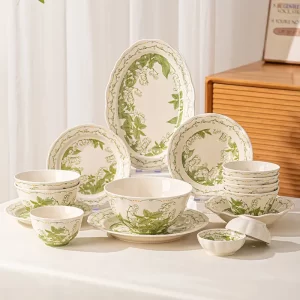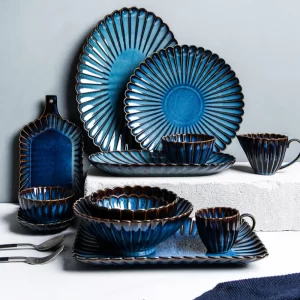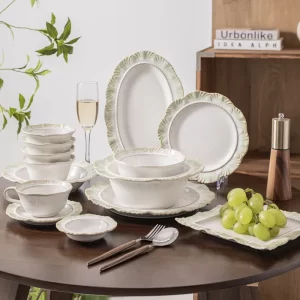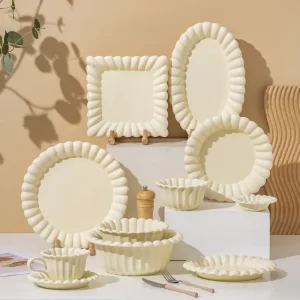

Amidst the ever-evolving global market for tableware sourcing, an increasing number of brands, restaurant chains, and cross-border e-commerce sellers are turning their attention to the customization capabilities of “custom dinnerware.” Compared to standardized products, custom dinnerware not only strengthens brand identity but also enhances product premium potential and market differentiation. However, during the actual procurement process, the most common question clients face is often not “should we customize?” but rather “which aspect of customization offers the best value?”
In the realm of ceramic tableware customization, there are two primary core directions: Shape Customization and Glaze Customization. The former involves mold development and structural design, while the latter pertains to color, texture, and firing techniques. Both factors influence the final cost, yet the manner and magnitude of their impact differ significantly.
For buyers, understanding the cost logic behind these two customization methods is a critical step toward optimizing supply chain budgets, alleviating inventory pressure, and maximizing the ROI of custom dinnerware investments. This article will provide an in-depth analysis of how these two approaches impact pricing—examining manufacturing processes, cost structures, real-world case studies, and procurement strategies—to help B2B clients make more efficient and informed purchasing decisions.
I. What is Shape Customization? Why Does It Have a Greater Impact on Cost?
Within the production ecosystem of custom dinnerware, shape customization typically refers to the structural redesign of ceramic products—for instance, altering the rim shape of a plate, the depth-to-width ratio of a bowl, or the handle design of a cup. The primary cost driver in this type of customization is “mold development.”
Ceramic production relies heavily on molds; creating a new shape almost invariably requires creating a new mold. Mold fees typically range from tens to hundreds of dollars, with large or complex structures incurring even higher costs. Furthermore, the development cycle typically spans 15 to 30 days, encompassing design confirmation, prototyping, mold refinement, and test firing.
For example, while the production cost for a standard round dinner plate may be relatively low, shifting to an irregular, artistic rim design or a compartmentalized plate layout requires the creation of new plaster molds and increases the complexity of the molding process. This directly results in a 10% to 40% increase in unit costs.
In custom dinnerware orders, the greater the complexity of the shape, the higher the reject rate tends to be, as the molding and firing processes become more susceptible to deformation or cracking. Consequently, shape customization is typically the “single largest variable” influencing overall production costs. For clients with limited budgets who still wish to achieve brand differentiation, a “basic mold + localized optimization” approach can be adopted. For instance, one might simply adjust edge contours or introduce subtle structural modifications to lower overall development costs while preserving the unique character of the custom dinnerware.

II. How Does Glaze Customization Affect Cost? Seemingly Simple, Yet Full of Hidden Variables
Compared to shape customization, glaze customization for custom dinnerware is often perceived as being “more flexible and economical”; however, the reality is not quite so straightforward.
Glaze customization primarily encompasses processes such as color adjustment, matte/gloss finishes, crackle glazes, gradient glazes, and hand-applied glazes. Although it does not entail mold development, its costs stem primarily from three areas: raw material formula adjustments, firing temperature control, and yield rate management.
For example, a standard monochrome glaze is relatively inexpensive; however, utilizing kiln-variation glazes or multi-layer gradient glazes requires multiple glazing and firing cycles, extending the production lead time by 20% to 50%. Furthermore, temperature variations within the kiln can lead to color discrepancies, thereby driving up quality control costs.
In the context of mass-producing custom dinnerware, the greatest cost risk associated with glaze customization lies in “consistency.” Even within a single production batch, slight color variations may occur, necessitating additional grading or sorting—a process that increases both labor and inventory costs.
Conversely, from an advantage standpoint, glaze customization eliminates the need for new mold creation. Consequently, it is well-suited for small-batch market testing or rapidly launching new product lines—making it a popular strategy among cross-border e-commerce sellers for the rapid iteration of custom dinnerware.

III. A Production Process Perspective: Where Exactly Do Cost Differences Originate?
From the perspective of the ceramic manufacturing workflow, the cost of custom dinnerware is primarily determined by four key stages: design, molding, firing, and post-processing.
Shape customization primarily impacts the first two stages. The design phase requires structural engineering support, while the molding phase relies on the creation of new molds and subsequent trial-run adjustments; thus, the bulk of the costs is concentrated in “initial development.”
Glaze customization, conversely, primarily affects the latter two stages. The precise temperature control during firing—along with the chemical reactions of the glaze materials—determines the final aesthetic outcome; consequently, the costs in this instance are more closely tied to “production consistency and loss rates.” For instance, on the same production line, the yield rate for a basic white plate might reach 95%; however, if complex glaze effects are introduced, the yield rate could drop to 85% or even lower. This discrepancy can significantly impact total costs in large-volume orders for custom dinnerware.
Furthermore, production lead time is an integral part of the overall cost structure. Customizing shapes typically entails a longer development cycle, whereas glaze customization relies more heavily on batch control. This factor is particularly critical for clients with urgent orders.
IV. MOQ (Minimum Order Quantity) and Procurement Strategy: How to Minimize Overall Costs?
In B2B procurement, the MOQ (Minimum Order Quantity) is a pivotal factor influencing decision-making. Regarding custom dinnerware, shape customization typically demands a higher MOQ because the associated mold costs must be amortized across the production run; glaze customization, conversely, offers greater flexibility.
In its actual operations, Yongjian Ceramics supports lower MOQs; the specific MOQ for different products varies based on their complexity. This approach enables small and medium-sized brands to launch custom dinnerware projects flexibly without incurring excessive inventory pressure.
For example, standard-shaped dinnerware may qualify for lower MOQs for trial orders, whereas products with complex shapes require higher MOQs to cover the mold costs. However, by adopting a phased procurement strategy—starting with a small batch to validate market reception before scaling up the order—clients can effectively mitigate risk.
Additionally, we recommend that buyers adopt a “stable shape + variable glaze” strategy—that is, maintaining a consistent basic structure while creating product series through the application of different glazes. This approach is widely prevalent in the custom dinnerware market, allowing for maximum cost control while simultaneously ensuring product diversity.
V. How to Choose: Shape or Glaze? A B2B Decision-Making Model
Different types of buyers require distinct procurement strategies.
If the primary objective is brand building and the development of a long-term product line, shape customization is the more suitable choice. It establishes a unique product identity and serves as a core competitive advantage for high-end custom dinnerware.
If the goal is to rapidly test market reception or to launch a broad range of SKUs, glaze customization offers distinct advantages. It facilitates the swift introduction of multiple stylistic series while keeping development costs in check.
From a holistic cost perspective, shape customization has a greater impact on initial capital outlay, whereas glaze customization has a greater bearing on long-term production stability. Consequently, in the realm of custom dinnerware procurement, the optimal strategy often involves a combination of both approaches rather than relying on a single choice.

Conclusion
In summary, within the realm of custom dinnerware, shape customization and glaze customization represent—respectively—the “structural innovation cost” and the “visual presentation cost.” The former determines the initial investment required for product development, while the latter impacts production stability and per-batch costs.
For buyers, there is no single option that is absolutely “cheaper”; rather, there is only the choice that best aligns with their specific business objectives. If working with a limited budget, prioritizing glaze customization is often the most practical approach; conversely, if the primary goal is to establish strong brand differentiation, shape customization offers greater long-term value.
A sound strategy typically involves using a stable, established shape as a foundation while creating product variations through changes in glazing. This approach strikes a balance between cost efficiency and market appeal, thereby maximizing the commercial value of your custom dinnerware.
About Yongjian Ceramics
Established in 1990, Yongjian Ceramics is a professional manufacturer and wholesale supplier of ceramic tableware. We specialize in producing high-quality ceramic plates, bowls, cups, baking dishes, spoons, and other related products. With extensive experience in the field of custom dinnerware, we offer comprehensive OEM/ODM services, allowing clients to customize shapes, glazes, and packaging to meet their specific requirements.
Furthermore, we offer flexible low-MOQ (Minimum Order Quantity) solutions to help brands, e-commerce sellers, and food service clients launch their custom projects with greater ease. Specific MOQ requirements vary depending on the product type and the complexity of the customization; please contact our sales team for detailed proposals and price quotes.

FAQ
- Is shape customization always more expensive than glaze customization?
Generally, yes. This is because shape customization involves mold development and structural design, which significantly increases upfront costs. However, the actual cost ultimately depends on the complexity of the product and the order quantity.
- Is it possible to order custom dinnerware in small batches?
Yes. Yongjian supports low-MOQ trial orders—though specific quantities must be confirmed based on the product type—making it an ideal solution for testing new products in the market.
- Does glaze customization affect product safety?
No. Glaze customization pertains solely to aesthetics and surface finishes; provided that the materials meet food-grade safety standards, the customization process does not compromise product safety.
- How can I reduce the overall cost of custom dinnerware?
We recommend adopting a strategy that combines standard shapes with varied glazing options. Additionally, placing orders in stages can effectively mitigate development risks and inventory-related costs.
- How long does it take to develop a new shape?
Typically, the process takes 15 to 30 days, encompassing design, mold creation, prototyping, and test firing stages. More complex products may require a longer development period.